

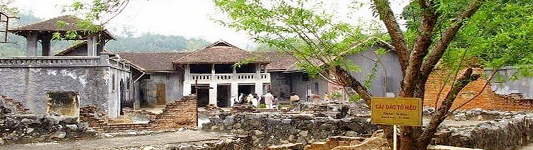
A prominent highlight of Phieng Khoai is the Vietnam - Laos Revolutionary Historical Site in Lao Kho, which preserves memories of the revolutionary activities of President Kaysone Phomvihane and the special solidarity between the Vietnamese and Lao people. The site was built on an area of nearly 50 hectares with many structures, including the Friendship Monument, the Vietnam - Laos Friendship Memorial House, the former house foundation of Trang Lao Kho, and the camps of the Lao Bac (Northern Laos) Vanguard Unit during the 1948-1951 period.
In 2022, the Vietnam - Laos Revolutionary Historical Site was recognised as a special national relic site, becoming a “red address” for educating younger generations about patriotism and international solidarity. In recent years, the site has attracted many groups of students, young people, and visitors who come to learn about history.
 The Vietnam - Laos Revolutionary Historical Site was recognised as a special national relic site in 2022.
  The mysterious beauty of Ta En 3 Cave in Phieng Khoai commune, featuring multiple layers of stalactites and small lakes.
Not far from the Lao Kho Historical Site, winding roads along the mountainsides lead visitors to Ta En Cave, a natural attraction that still retains its untouched beauty. The cave system consists of three large caves hidden within deep green forests, ranging from 500 to 1,000 metres in length. Inside are underground streams, small lakes, and uniquely shaped stalactites. The cool climate year-round makes it an attractive destination for travellers who enjoy exploring nature.
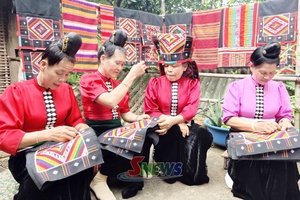
Currently, Phieng Khoai commune is coordinating with provincial departments and agencies to complete documents proposing Ta En Cave for recognition as a provincial scenic site, laying the foundation for future eco-tourism and adventure tourism development. At the foot of Ta En Mountain lives the Xinh Mun ethnic community. Their traditional houses, folk dances, khen (panpipe) music, and mountain- and forest-flavoured cuisine have been preserved through generations. This also provides a foundation for developing community tourism associated with indigenous cultural experiences.
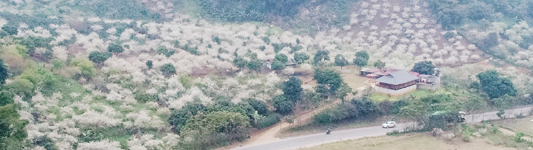
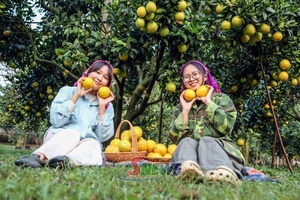
Phieng Khoai also attracts visitors for its flower and fruit seasons characteristic of the highlands. These days, as the plum harvest season begins, hillsides are covered in the red-purple colours of heavily laden plum orchards. In the orchards, many tourists enjoy picking and tasting ripe plums right under the trees.
Based on its available potential, the Party Committee of Phieng Khoai commune has issued a community and eco-tourism development project for the 2025-2030 period. The commune is focusing on developing community tourism products, agricultural tourism, flower-season tourism, and “Returning to the Vietnam – Laos Roots” tours. It is also gradually forming community tourism hamlets in Con Huot 2 and Dan Don, developing homestay systems, training human resources, and promoting tourism through digital platforms.
 Plum orchards covered in pure white blossoms or filled with ripe fruit during harvest season have great potential to attract visitors for sightseeing and hands-on experiences.
At present, Phieng Khoai still faces many difficulties in transportation infrastructure, accommodation services, and tourism human resources. Tourism products mainly remain at the level of individual sightseeing and experiences, while distinctive tours and tourism routes capable of retaining visitors have yet to be formed. In response, the locality is continuing to mobilise state budget funding and social resources to invest in and upgrade tourism infrastructure, strengthen cooperation with travel companies, and gradually standardise homestay services, food safety, and tourism safety in order to improve professionalism at the destination.
From “red addresses” rich in historical values and pristine natural landscapes, to plum orchards entering the harvest season, Phieng Khoai today is gradually awakening its tourism potential by making use of its inherent advantages. With appropriate orientations and the support of local people, this borderland is opening up opportunities to become an attractive new destination of Son La and the northwestern region of Vietnam.
.jpg)



You have 500/500 characters left
Please enter 5 or more characters!!!