



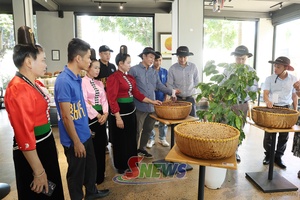
A rice cake pounding competition at the Mong ethnic cultural festival in Suoi To commune.
In Ta Xua commune, where 100% of the population is Mong, everyone knows Mua A Chu from Lang Cheu village. Now over 50 years old, he has consistently maintained the craft of making and teaching villagers and younger generations how to perform the Mong khen (panpipe). Recently, Chu, together with cultural practitioners Phang A Tu and Lu A Vang, and his son Mua A Tong, directly taught a class on crafting and performing the Khen. The course was jointly organised by the provincial Culture - Cinema Centre and Ta Xua commune, with 40 trainees.
Mua A Chu shared that crafting a standard flute requires meticulous attention at every stage, from selecting bamboo and wood, making the reed, assembling the pipes, to tuning the instrument. Khen players must also master blowing techniques and breath control. The trainees were embedded in basic flute dances, traditional performance postures, and the cultural meanings of each melody. “Through these classes, I hope young people will love their culture more and feel responsible for preserving the traditional culture of our ethnic group,” he said.

Young men in Ta Xua commune learn to make Mong flutes.
Preserving the traditional craft of flax spinning and weaving, Song Thi Du established the Mong Ethnic Costume Embroidery and Tailoring Cooperative Group in Ta Xua commune, with 20 members. In addition to creating impressive brocade products and souvenirs for tourists, the group’s members also pass on the craft to their children and grandchildren, helping preserve traditional skills while providing sustainable livelihoods for local women. Du shared that with the support of the provincial Women’s Union, she founded the cooperative group in 2019. Members receive training in basic household financial management, entrepreneurship, production and business planning, and also have opportunities to learn from experience in other localities.
Preservation efforts are not only made by village artisans but are also continued by intellectuals and artists of Mong origin. Members of the provincial Literature and Arts Association such as Mua Thi Ganh from the Phu Yen Literature and Arts Branch, Va Thi Lia from the Son La city Literature Branch, Thao A Mua and Mua A Phenh from the provincial Folk Arts Branch, and Lau Tu Anh from the Music Branch, carry both knowledge and a deep love for their culture. They actively collect, preserve, and convey Mong literary values, poetry, and oral traditions through artistic and literary works, introducing them to a wide readership.
In particular, Ho A Di, a member of the Song Ma–Sop Cop Literature and Arts Branch, is a researcher with profound understanding of Mong culture and folk literature. He has consistently linked his creative career to practical issues in the life of the Mong community. To date, he has published dozens of works and won numerous awards in national and local writing contests. These include the Vietnamese–Mong bilingual poetry collection “Hoa den no” (Blooming lamp flowers), conveying messages against social evils; short stories such as “Nguoi tin cu” (The former lover) and “Tro ve” (Returning home), mentioning migration issues; and “Troi cho chung minh thuong nhau” (Heaven allows us to love each other), which emphasises developing traditional crafts into marketable goods for sustainable livelihoods. His research work “Ma bo” is also a valuable reference on Mong customs and practices.

The Mong people of Ta Xua preserve the traditional craft of making traditional costumes.
In recent years, many tangible and intangible cultural heritages of the Mong people have been researched, preserved, and promoted. Notably, clan worship rituals, the khen art, and the art of creating decorative patterns on Mong costumes in the Moc Chau area have been recognised by the Ministry of Culture, Sports and Tourism as National Intangible Cultural Heritage. This recognition is not only an honour but also a motivation for Mong cultural practitioners to actively preserve and pass on traditions, sowing seeds of cultural pride and love among younger generations.
The persistent efforts of these cultural custodians have made a significant contribution to preserving the Mong ethnic identity amid modern life. Through this, the Mong cultural heritage continues to be promoted, enriching the spiritual life of the residents and becoming a valuable potential and attraction for the development of community-based tourism and cultural-historical tourism in the locality.

.jpg)
You have 500/500 characters left
Please enter 5 or more characters!!!