





.jpg)
Established in 2013 with 25 members, Binh Thuan Production, Business and General Services Cooperative in Binh Thuan commune initially aimed to restore and develop the traditional tea-growing area while creating a stable market for local tea growers. During its early years, cooperative staff visited households to encourage farmers to maintain their tea plantations, vowing to purchase all fresh tea leaves at reasonable prices.
From only a few dozen participating households at the beginning, the cooperative has now partnered with around 500 farming households in the commune and neighbouring areas, establishing a large tea-growing region covering about 800 hectares. In 2019, the "Trong Nguyen Tea – Phong Lai Thuan Chau" brand was officially launched and recognised as a provincial four-star OCOP (One Commune One Product) item.
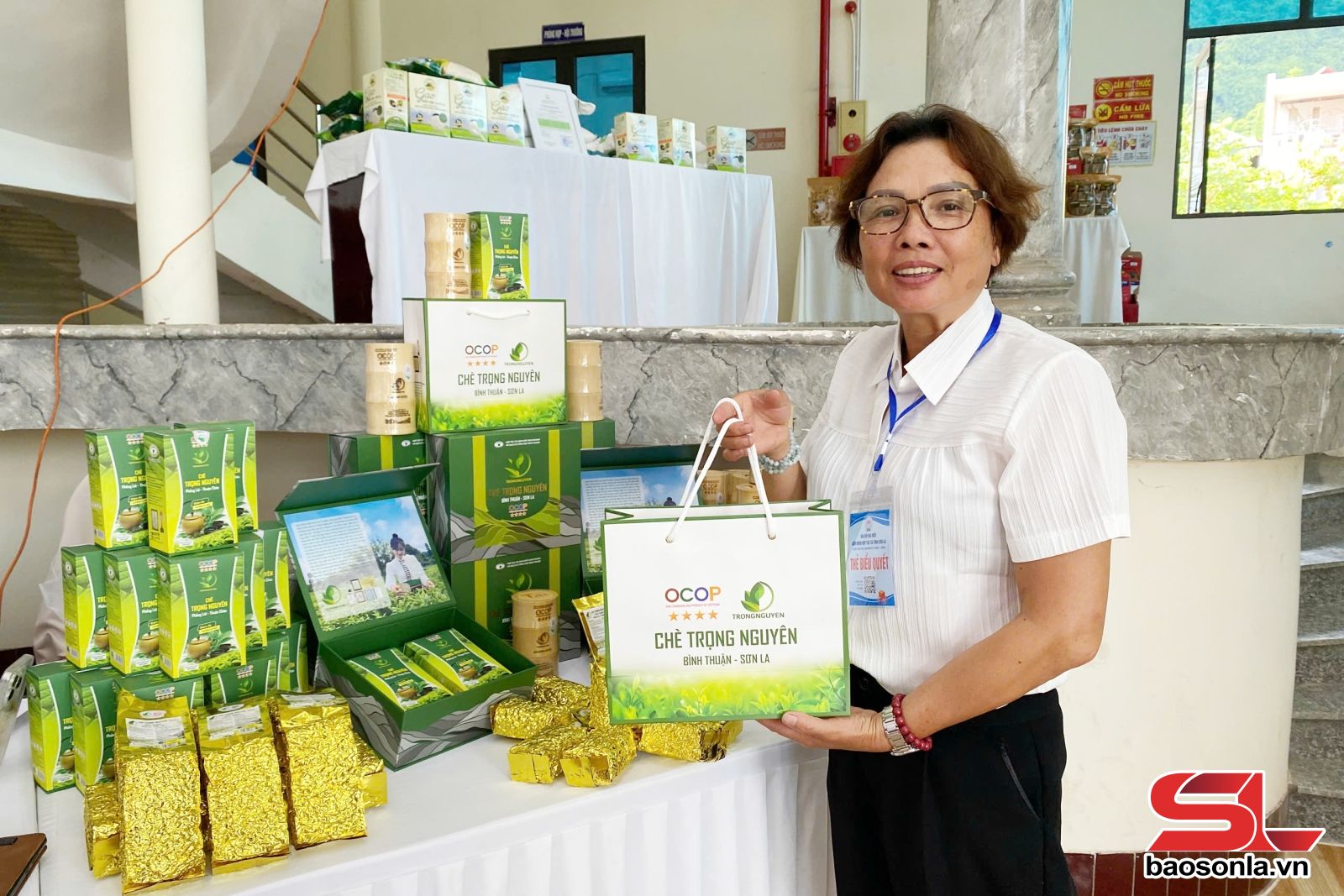
Nguyen Thi Binh, Deputy Director of the cooperative, shared that the cooperative purchases 2,500 tonnes of fresh tea leaves annually and processes between 400 and 500 tonnes of finished tea products for domestic consumption and export to Taiwan and the Republic of Korea. Tea production generates more than 100 million VND (3,900 USD) per hectare each year.
The cooperative provides permanent employment for 10 workers and seasonal jobs for 35 workers (9–10 months annually), with average monthly incomes ranging from 8–10 million VND. In addition, hundreds of partner households earn stable incomes from tea cultivation, averaging 60–80 million VND per household per year.

Established in 2016 with eight members, Tay Bac Cooperative in Yen Chau commune chose a different development strategy from the outset by focusing on deep processing of local agricultural specialties instead of simply selling raw materials. Using locally available products such as garlic, Shan Tuyet tea, bananas, mangoes, and plums, the cooperative has invested in machinery and modern technology to produce a wide range of value-added products that meet increasingly diverse market demands.
The cooperative has also developed numerous specialty products, including On Oc Shan Tuyet tea, dried male papaya flowers, green banana powder, dried bananas, dried mangoes, dried plums, and dried longan. After nearly a decade of development, it has achieved 12 OCOP-certified products, including two four-star items. Its annual revenue reaches 4–5 billion VND, providing stable employment for local workers while increasing incomes for hundreds of households supplying raw materials.
Deputy Director Nguyen Anh Duc said the cooperative has remained committed to deep processing rather than selling raw agricultural products. Fresh garlic in Yen Chau is priced at around 25,000–30,000 VND per kg, but after being processed into black garlic, its value rises to 400,000–600,000 VND per kg, an increase of 15 to 20 times.

To date, the province has 824 cooperatives with approximately 42,000 members. Among them, 99 participate in developing 125 OCOP products. The total operating capital of cooperatives is estimated at around 700 billion VND. Average annual revenue reaches 3.6 billion VND per cooperative, while members earn an average monthly income of 6–7 million VND.
Mui Anh Tien, Chairman of the provincial Cooperative Alliance, emphasised that the alliance will continue to play a leading role in developing the collective economy by strengthening public awareness of the importance of cooperatives. At the same time, it will enhance representation and protect the legitimate rights and interests of cooperatives, improve advisory, training, trade promotion, and financial support services, and accelerate digital transformation and the application of science and technology.
The alliance will also promote high technology, circular economy, and organic agriculture, strengthen value-chain production linkages, expand international cooperation, support brand building and OCOP product development, and replicate successful cooperative models. These efforts aim to contribute to sustainable, modern, and internationally integrated socio-economic development.
In fact, cooperatives have become effective links between farmers and the market, helping increase the value of agricultural products, generate employment, and improve people's livelihoods. This further confirms the important role of the collective economy in promoting local socio-economic development./.
















You have 500/500 characters left
Please enter 5 or more characters!!!