


Currently, Long Phieng commune is home to seven cooperatives operating in the agricultural and agricultural services sectors. These cooperatives not only serve as a bridge connecting production and product consumption but also introduce scientific and technological advances, helping farmers shift from small-scale production to concentrated commodity production. Their effectiveness is reflected in the average annual income of cooperative members, ranging from 300 million VND to 2 billion VND (70,000 USD).
Established early and recognised as one of the bright spots of the collective economy in Long Phieng, Phuong Nam Cooperative has experienced remarkable growth over the past ten years. From an initial cultivation area of about 80 hectares, the cooperative has expanded its network to include 30 farming households and increased its longan-growing area to more than 300 hectares, creating a large-scale specialised production zone that meets market demand both within and outside the province. In addition, the cooperative has diversified into other high-value fruit crops, including durian custard apple, avocado, and banana.
 Members of Phuong Nam Cooperative harvest longans.
In response to increasingly stringent market requirements, the cooperative has proactively shifted toward clean agricultural production and the application of scientific and technological advances. Tran Nhu Kien, Director of Phuong Nam Cooperative, shared that the cooperative regularly organises training courses and technical transfer programmes for members and affiliated households. These activities focus on pest and disease control based on the “Four Rights” principle, prioritising the use of biological products and environmentally friendly solutions to minimise chemical residues and ensure product quality.
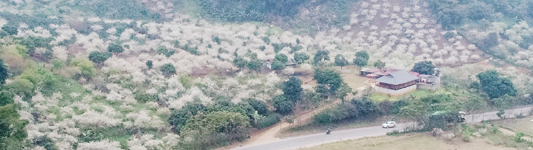
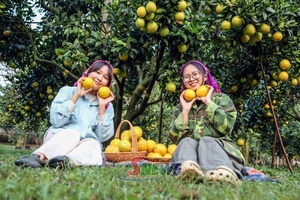
 A fruit-growing area in Long Phieng commune.
Thanks to the synchronous application of technical solutions and efficient production organisation, Phuong Nam Cooperative harvests more than 5,000 tonnes of fresh longans annually, with an average selling price of around 12,000 VND per kg. Income from longan cultivation reaches about 150 million VND per hectare. Beyond improving the livelihoods of members and affiliated households, the cooperative also creates stable employment opportunities for many local workers.
With more than 1,035 hectares currently under cultivation, ‘hau’ plum has become one of the key crops in Long Phieng, with total production exceeding 9,600 tonnes in 2026. In recent years, local farmers have increasingly adopted advanced production techniques and sustainable farming practices, contributing to higher product quality and value.
Established in 2023, Khanh Duong Cooperative in Yen Thi hamlet currently has eight members managing more than 30 hectares of crops, including approximately 20 hectares of ‘hau’ plum. Recognising quality as the key factor determining product competitiveness, the cooperative has guided its members in applying VietGAP production standards and strictly controlling every stage from cultivation to harvest.
 A members of Khanh Duong Cooperative in Long Phieng commune harvests ‘hau’ plums.
Tran Van Thuc, Director of Khanh Duong Cooperative, stated that plum production is expected to exceed 400 tonnes in 2026. The cooperative’s ‘hau’ plums are not only sold through traditional traders but are also supplied to clean-food stores, supermarkets, and distribution chains in various localities. The cooperative is working toward building and promoting the “Long Phieng Plum” brand, thereby enhancing the value of local agricultural products and expanding market access.
In practice, the development of cooperatives has played a significant role in forming concentrated production zones, improving agricultural productivity, and creating sustainable livelihoods for local residents. Through effective production linkage models, farmers have gradually changed their mindset, become more confident in applying science and technology, improved product quality, and moved toward standardised safe production.
 Members of Khanh Duong Cooperative in Long Phieng commune harvest ‘hau’ plums.
Lu Van Chung, Chairman of the Long Phieng commune People's Committee, stated that the commune will continue developing specialised fruit-growing areas, strengthening technology transfer, encouraging value-chain production linkages, and promoting the application of high technology in agriculture. At the same time, it will focus on replicating effective production models and integrating collective economic development with the implementation of digital transformation programmes in agriculture. These efforts provide an important foundation for enhancing the competitiveness of agricultural products and meeting increasingly demanding domestic and export market requirements.
With strong support from local authorities as well as the proactiveness and creativeness of cooperatives and farmers, the collective economy in Long Phieng is opening up a sustainable development pathway for the agricultural sector. It will continue to serve as a key driver in building a modern commodity-based agricultural economy, increasing the value of agricultural products, and effectively implementing the National Target Programme on New-style Rural Development in the new phase.

You have 500/500 characters left
Please enter 5 or more characters!!!