


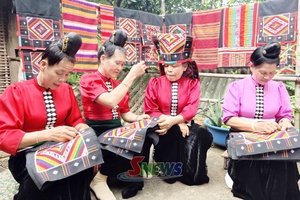
 La Ha women in Chieng La commune.
The La Ha and Khang communities each account for less than 1% of Son La's population, while the Kho Mu people make up about 1.3%. These ethnic groups have lived in Son La for generations, possess their own languages, and are included in the list of disadvantaged ethnic minorities under the decision of the Ministry of Ethnic and Religious Affairs. Living alongside the Thai ethnic group has inevitably influenced aspects of their cultures. Nevertheless, the La Ha, Khang, and Kho Mu people have successfully maintained their distinctive cultural identity through traditional rituals, beliefs, costumes, folk songs, and folk dances. Among the most notable traditions are the Xe Pang A (peace-praying) ritual of the Khang people and the Pang A ceremony of the La Ha people, both of which have been recognised as national intangible cultural heritage. Documentation is also being prepared to seek national heritage recognition for the Kho Mu New Year Celebration.
 Members of the La Ha Cultural Club in Bung Lanh hamlet, Quynh Nhai commune, rehearse traditional performances.
In recent years, cultural preservation for smaller ethnic communities has received increasing attention through a range of practical initiatives. In Quynh Nhai commune, La Ha and Khang hamlets are encouraged to maintain community performance groups and ethnic cultural clubs to help preserve their cultural identity. Lo Thi Tinh, head of the La Ha Cultural Club in Bung Lanh hamlet, said that the club has 35–40 members of different ages, including two Meritorious Artisans. Members regularly practice traditional dances such as Tang Bu and Hun May, while elders teach younger generations about their ethnic customs, beliefs, and ceremonial practices, creating opportunities for mutual learning and stronger community bonds.
Traditional culture also continues to thrive in La Ha hamlets with strong support from local authorities. In Phieng Nong hamlet, Chieng La commune, the community has maintained a cultural performance team and a Kho Mu Folk Culture Club for many years. The club organises cultural exchange activities, training courses for community performers, and enables members to participate in major cultural events organised by the provincial and local authorities, providing valuable opportunities for learning and cultural exchange.
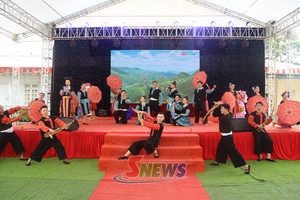
 The Kho Mu Folk Culture Club of Chieng La commune performs the New Rice Offering Ceremony at Tay Bac Square.
Folk artisan Lo Van On, a respected elder of Phieng Nong hamlet, shared that the Kho Mu people continue to preserve many traditional ceremonies, including the New Rice Offering Ceremony and the Magro harvest-praying ritual. Their cultural heritage also includes tom folk singing, as well as traditional musical instruments such as the tang bu, bamboo string instruments, and drums. Beyond expressing gratitude to spiritual deities and praying for abundant harvests, these ceremonies also teach younger generations the importance of protecting forests, conserving water resources, and maintaining solidarity within the community. For this reason, elders remain committed to passing these traditions on to future generations.
 The traditional Can wine festival of the Khang ethnic community.
In recent years, Son La province has actively cooperated with organisations and businesses to develop sustainable cultural facilities in disadvantaged communities. Notable examples include the La Ha Community Cultural Space in Chieng Lao commune, covering 365 square metres with an investment of nearly 2.5 billion VND (95,070 USD) funded by Vietnam Electricity (EVN); the La Ha Community Cultural House in Muong Khieng commune, jointly supported by the Vietnam Youth Federation and Sacombank; and the Khang Community Cultural House in Chieng Lao commune, funded by the provincial Youth Union. These facilities serve as venues for preserving cultural artifacts and traditional performance equipment, organising community activities, strengthening ethnic solidarity, and fostering pride in preserving traditional culture.
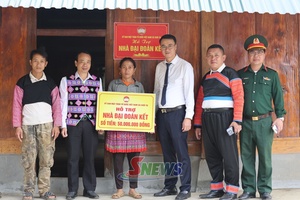
_1767081953_1783134992.JPG) The Khang Community Cultural House in Chieng Lao commune is inaugurated.
The Khang Community Cultural House in Chieng Lao commune is inaugurated.
Regarding the province's cultural preservation strategy, Pham Hong Thu, Deputy Director of the Son La Department of Culture, Sports and Tourism, said that the department is actively implementing the project "Building and Developing the Culture and People of Son La to Meet the Requirements of Sustainable Development", as well as the project "Preserving and Promoting the Values of Folk Songs, Folk Dances, and Traditional Music of Son La's Ethnic Minorities in Association with Tourism Development" for the 2021–2030 period. It also provides guidance on establishing and maintaining cultural clubs, organising heritage transmission classes, training community arts groups, promoting the role of traditional artisans, and restoring and showcasing recognised cultural heritage as part of community-based tourism development.
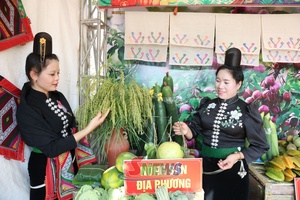
 The traditional attire of La Ha women in Quynh Nhai commune.
With sound policies from the Party and the State, practical preservation measures, and a renewed sense of pride and responsibility among cultural heritage bearers, the unique cultural values of the La Ha, Kho Mu, and Khang communities will continue to be preserved in the right direction. As a result, their rich cultural heritage will continue to flourish, enriching the spiritual life of local people while adding further colour and diversity to the cultural identity of Son La.
.jpg)

You have 500/500 characters left
Please enter 5 or more characters!!!